
Laboratory

Research & Interests
We investigate the communication between immune cells during chronic autoimmune and cancers, as well as inflammatory diseases. These diseases are often molecularly heterogeneous, requiring personalized therapeutic approaches. Our lab utilizes systems biology and bioinformatics to monitor the immune system throughout disease progression.
By integrating laboratory and clinical data, we identify dysregulated biological pathways at the patient level. These findings allow us to hypothesize the roles of these pathways as pathogenic factors or biomarkers, which can be tested in vitro and therapeutically targeted.
우리 연구실은 만성 자가면역 및 염증성 질환 뿐만 아니라 암에서 면역 세포 간의 상호작용을 연구하고 있습니다. 이러한 질환들은 분자적으로 이질적이기 때문에 개인 맞춤형 치료가 필요합니다. 우리 연구실은 시스템 생물학과 생물정보학 기법을 활용하여 질병 진행 동안 환자의 면역계를 모니터링합니다. 실험실 및 임상 데이터를 통합하여 환자 수준에서 이상 조절된 생물학적 경로를 발견합니다. 이를 바탕으로 병원성 인자로 작용하거나 바이오마커로 사용될 수 있는 경로를 가설로 세우고, 이를 실험실에서 검증하거나 치료 타겟으로 활용합니다.
We are currently work on autoimmune diseases, cancers and other diseases

Autoimmune disease
There are many autoimmune disease with various reasons. We are focused on activity of immune cells in disease states. Analyzing single-cell RNA sequencing and spatial transcriptomics data, we find out disease specific immune cell transcriptomic profiles and interactions in disease sites.

Cancer
Cancer is one of the most complex disease in human. Immune cells in tumor microenvironments play crucial role for tumor progression or regression. By analyzing transcriptional profile in immune cell, we revealed cancer specific immune cells' features

Other disease & works
We also work on many other diseases. For example, we analyze gene expression profiles during blood brain barrier (BBB) breakdown. We also study hepatocyte subtypes and related cells during liver regeneration. We analyze not only human data, but also many other model organism datas.
Autoimmune disease
Psoriasis
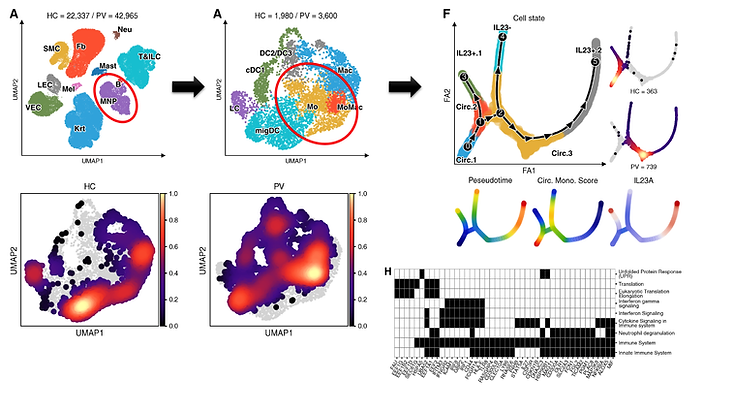
Psoriasis vulgaris (PV) is a common chronic inflammatory skin condition caused by overactive type 3 immunity. We investigated the upstream regulators of pathogenic T17 T cells in PV. Through detailed analysis of mononuclear phagocytes, we discovered a new PV-specific subset of monocytes that express IL23.
We then found that these monocytes interact with inflammatory vascular endothelial cells (VECs). Using spatial transcriptomics, we confirmed the presence of these three distinct cell states and demonstrated their spatial colocalization. Our analysis of the PV inflammatory microenvironment provides insights into potential therapeutic strategies.
Cancer
Lung Cancer

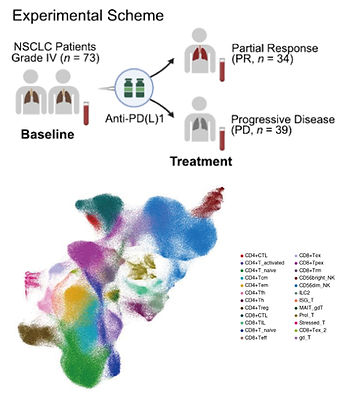
We emphasize the clinical advantages of anti-PD-1 in treating Lung Cancer, especially for stage 4 patients. We also simultaneously sampled the primary tumor and metastatic site.
Additionally, analyze PBMC from paired samples. By these scheme, we can analyze local TME and systemic PBMC of Lung cancer patients. Further more, by combining immune cell profile of TME and PBMC, we can track immune cell's differentiation and changing of their transcriptome.
Other works
Neurodegenerative disease

Phelan-McDermid syndrome (PMS) is a rare neurodevelopmental disorder caused by SHANK3 gene deletions or mutations, leading to disrupted synaptic function and neural connectivity.
Ongoing research aims to uncover the underlying mechanisms and identify potential therapeutic targets to address the associated cognitive and neuropsychiatric symptoms.